
Summary –
Six months ago when I started training for my 8th Ironman attempt I was excited at the idea of striking back up the blog and documenting my journey towards the goal of a PR and sub-10 hour Ironman at 40. However as the training grew the writing ceased, not for a lack of ability or desire, from the fear of embarrassment from another let down after what I would consider 6 pretty terrible Ironman experiences. In 2011, at the age of 27, I did Placid for the first time with minimal training volume, only a couple centuries and barely any bricks. I didn’t know what I was doing nutrition or equipment wise, I just went out there to have fun and loved every second of it, finishing pretty well in my age group at 10:46.
Following Placid I had some really horrible disasters. Placid take 2 while bending over to put my wetsuit on the morning of the race I threw my back out and competed the rest of the day in agony, to a new PR but in constant pain. Next I went to Mt Tremblant and got another PR but experiencing piriformis pain out of the water and throughout the bike. At Texas I biked fast but neglected nutrition, cramping in every lower body muscle trying to dismount my bike and walking a 6 hour marathon, then in Tahoe I suffered altitude sickness, passing out briefly in T2 before hobbling a slow walk/run marathon into the twilight hours. I was told early on that “Ironmans are supposed to hurt” so I started to assume that was how it was meant to be, that beginning the run was supposed to feel like death.

I’m not sure exactly what it was with this IM California attempt. Perhaps the extra muscle gained form years of lifting outside of triathlon, improved equipment (bike, wheels, shoes, Garmin’s, etc), constant nutritional practice and fixation with getting comfortable fueling at targets, maturity with age that included longer special need stops and stretching, or a flat/fast course. But, for the first time I was finally able to feel what it’s like to not suffer (no cramping, walking or debilitating pain). I enjoyed a super relaxed scenic swim, biked 112 miles wishing it wouldn’t end and ran a marathon without the need to stop once. It did hurt, but nothing like before. For near 10 hours it was just another long training day minus a few final miles of painful running.
I’ve considered how to write this report, for my family/friends, fellow triathletes or myself. I decided on all three so I’ll break it down into sections as such. I’d like to briefly mention my happiness and appreciation for this sport and those that have been accommodating, break down how I was finally able to achieve my goals after half a dozen attempts, and memorialize the experience including finish line feels and friends along the way.
Regaining my Love of Triathlon –
Six years is quite the break and it flew by under the radar with Covid. I did enjoy weight training through 2020 while races were all being cancelled but the extra 35lbs made the return to running very difficult, especially with prior injury (calf issues). Gradual builds and a well thought out plan were paramount. I did tweak my calf a couple times in the start and a minor bike accident with bruised ribs had me very fearful at times, but the return to structured training had me mostly positive, even without a coach.
A friend once mentioned how easy it is for athletes to get hurt after breaks because we remember feeling strong but neglect our new bodies. So whatever pace was the norm we’re too quick to chase that, even though not ready, and inevitably get sidelined with injury. When I started running again the paces were very hard to accept, 4+ min/mile, then 3+ min/mile, and as I got a little more comfortable twice I “picked it up a bit” feeling good, and hurt my calf. When I look back now the bridge form 9+min/mile to 7:30/mile wasn’t that long, and as my body adjusted, fitness increased and weight went down, the speed increase was exponential, almost instant, however it needed it’s time. I’ve had friends with calf issues think they’d never run again, and now I know it’s possible, just realize you need to walk first (literally run/walk), start very slow, stretch, wrap, stay off hard surfaces, repeat over and over with slight (VERY slight) increases, trust in the process and eventually it happens. Perhaps not always but it is surely possible.
Another piece to this puzzle was stepping away from the norm and the criticism that came with it. I had a lot of friends question the commitment, that it wasn’t was worth the sacrifice, wondering why invest all that time, money and effort into something for the 8th time. I got some jabs for breaking form social rides for solo centuries along PCH weekend after weekend. The truth is twofold.. 1) It wasn’t that much of a sacrifice. What’s 2.5 months of specific training in beautiful SoCal in the scope of a lifetime or towards achieving a significant goal? and 2) you know I actually really enjoyed it! The 120 mile solo ride up PCH and 18 mile (5x San Vicente loop) were really great, partially because I knew this was a moment in time I may never get back (availability, fitness, location, etc) but also because despite the long hard effort it was pretty enjoyable. Not just the act of but immense feeling of reward and accomplishment following each difficult obstacle or minor improvement.
Finally I guess I really like the math. They say Ironman is mostly mental (apparently everything is) and though I don’t agree with that, as an engineer I can appreciate the numbers and graphs and how they can paint an accurate picture and roadmap to a goal. Hitting my 70.3 and Ironman predictions so accurately was very rewarding, but also finding happiness in results/metrics slower than before was a huge win. I remember doing races where I PR’d and felt discouraged, hyper focused on the next challenge or feeling insufficient. I don’t know if I ever really grasped my greatest performances until years later and those high bars created entry barriers for me wanting to reengage, knowing how difficult it’d be to break. When I look at my lifetime PR’s now I see plenty of early 2000’s and one 2024 –

But perhaps the better feeling is knowing I can find satisfaction outside of PR’s. I will struggle to best times or paces form this age out, but I do believe I will still find satisfaction in those results and be able to chase goals smaller, or different, than before. If I want to do another ironman at 50 for example, in an older body while balancing commitments, and I decide 11 hours is a significant accomplishment for me I believe I’ll be grateful with that outcome. Or quit running all together to get back in the gym and find healthier balance, I think I’ll be happy in a relay or aqua bike in the future. But It’s good to know that I’ll keep doing what I love and find satisfaction with it decades later in a sustainable and positive sense.
Raceday Recap –
Pre-Race:
Never before have I checked the weather so many times. The first year California was canceled due to an “atmospheric river”, and I saw countless blogs expressing the power of the wind in exposed areas of the bike, or cold of finishing in the rain. Not only was race day perfect but the whole weekend was amazing weather wise, showing off Sacramento in all it’s beauty.
The pre-race routine, checking-in, and winding down, all went according to plan. It was great to have Claire and my Mom there to go through the checklist and the Hansens around to do final workouts together including practice swim and bus to the race start. Perhaps the greatest was the final moments waiting for the sun to rise before entering the water, chatting about good times before and the race ahead as we peed ourselves. There was something magical about sharing in that experience 15 years after we started together and I wouldn’t trade it for the world.

Swim:
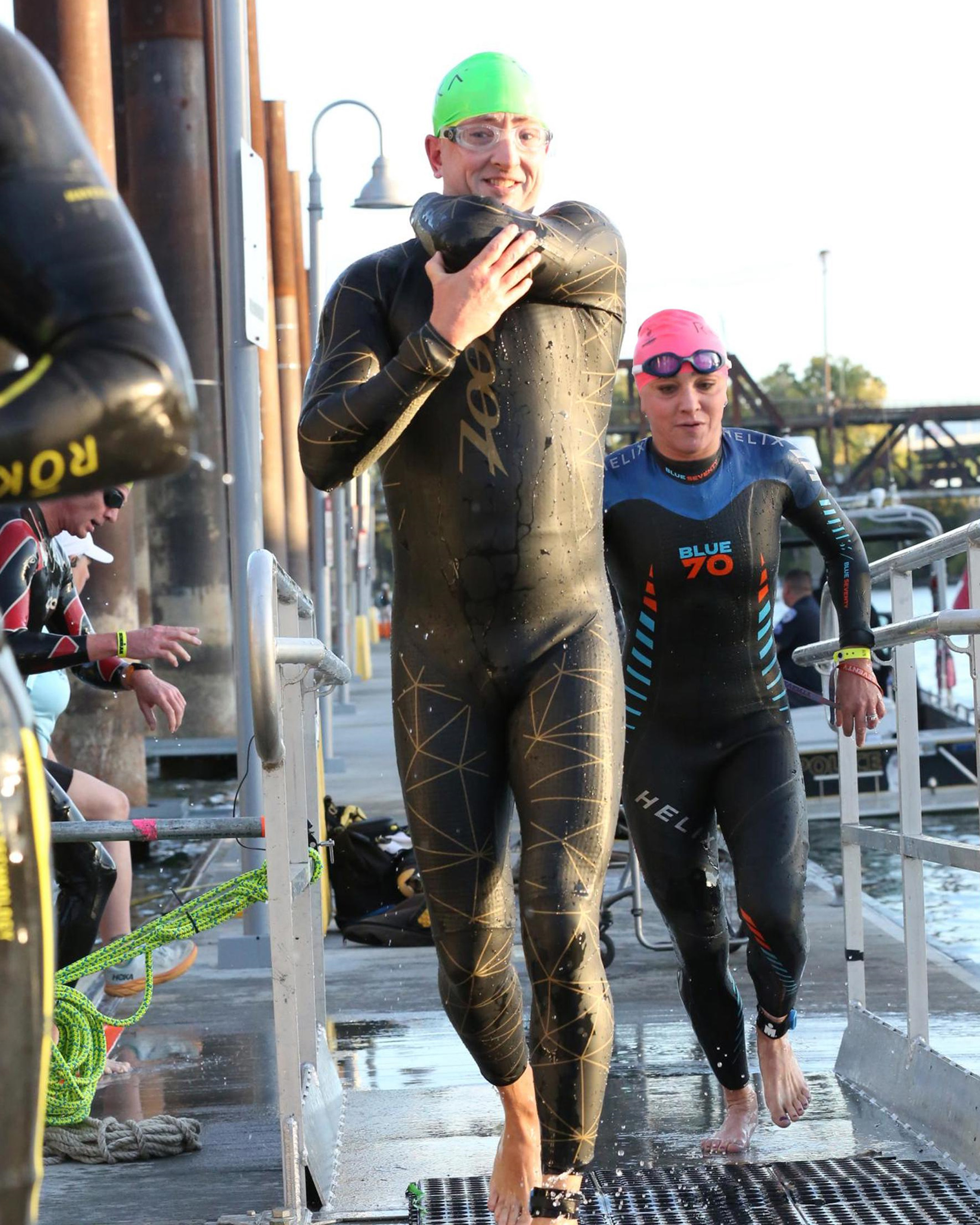
I asked a few others leading up to race day what the plan should be for the swim, to keep effort consistent with any other race or let the current take us to a relaxed PR as more of a warmup. I chose the latter, barely putting in a powerful stroke, which I felt was better achieving an effortless 48 minutes compared to a hard 45 minutes. I even stopped before the exit chute to stretch my piriformis in the water for a minute, which must have looked precarious to the lifeguards.
Two minor things, if you do this race make sure to start at the front and thus get to the chute early! I wish Ironman had a race based seating structure or at least a starting chute that lets you advance without knocking people over. Our placement didn’t just mean running into slower swimmers like crashing into rocks, but maneuvering those on the bike for the first 56 miles. Also, the experience from racing and Tower26 allowed me to navigate the current where others were all suffering, biggest example being the left turn buoy into the American River.

I exited the water feeling perfect and also coincidently next to my college teammate Jennie Hansen. She however ran past me at the changing tent, straight to her bike while I sat down to stretch again while changing, consuming fluids and building my composure for the bike ahead. Perhaps a slower T1 than others, but setting me up for another solid bike PR.
Bike:
This is where I started my race. I would break down the bike into 4 quarters, with only one really sizable to address. There were 2 out and backs, with a building wind in our face out and tailwind back into town. This made the first quarter less of a concern since wind was lower and adrenaline was high. My heart rate was elevated but in a way I was familiar with. I wanted 140bpm but was 150+. I used this time to focus on the course, taking in fluids and establishing a foundation for the 5 hours to come. At one point I practiced peeing before an aid station to rinse off after, which I thought I’d do each time, but that plan went out the window when I proceeded to pee myself 20+ times on the bike (a new PR!).
When we hit the turnaround the pace increased from 22mph to 23mph, a slight change in speed but at a much lessor effort in watts. I didn’t even really have the gearing to support consistent effort, and decided I’d use the back to fuel easier rather than increase cadence. A decision that might have killed me in the past thus creating a lot of anxiety, but somehow I knew it’s be fine. When we hit the half way (2:30) I was excited to see more fans cheering and also less athletes biking around me. It meant I could focus more on my race.

The third quarter was the only real effort of the race. The wind was building to a point where I actually felt unsafe drinking and found myself in the bars more than aero out of fear. The pace dropped substantially but I knew it would be ok once we rounded the last out-and-back. I didn’t think I’d break 5 hours but was confident it’d be well under 5:15, closer to my prediction of 5:06.

Once I rounded the final turn and started to feel a strong wind at my back the pace exploded at a super low effort. My watts were well under 200 but the pace was often 26mph+. This last stretch allowed me to consume fluids at a low HR. I had 4 1L bottles as well as a bottle segmented into 1/3 at T1, special needs and T2. At the century mark screaming home and watching my average speed grow closer to 22mph I couldn’t help to think back to all those races where I suffered HARD in the final miles, including 3 attempts at Lake Placid climbing “the bears” into town. I didn’t expect to finish feeling so good, almost wishing I could be out there longer. I don’t ever expect to get a 28 mile magic carpet ride in another Ironman, and cherished all of it.
Finally I really enjoyed my bike, not just the leg but what I was riding. My Speed Concept with Zipp Super-9 was comfortable, fast and sexy. I had multiple athletes say “DAYMMN!” as I passed and they weren’t talking about the speed. I particularly liked the PSI sensor in the wheel to display I wasn’t getting a flat, something I’ve always dreaded in a race. I had a healthy cushion to 10 hours in the end and I may not know how much of it was equipment, but I suspect the majority of it concerning biking 22MPH at 192watts NP was “not so free” speed.

Run:
I made the choice in advance once I hit transition to change into something dry and comfortable (which lasted only a few minutes), but also to consume a coke and stretch it out. I left transition and looked at “time of day” on my Garmin to show 1:25 which meant by the math (5:17 minus X = 1:25, X = 3:52) I could run a 3:52 and still cross under 10 hours! This had me hopeful enough to know it was possible while skeptical enough to ensure I didn’t do anything to F’up my chances right away.
I was even running out of T2 and made the hard conscious decision to stop at a light post and stretch both calves, sacrificing almost a minute. Usually when you see someone stretching on the run leg of an Ironman it means something has gone terribly wrong but for me it was the realization “I’ve stretched my calves at the start of EVERY training run, why would I not before the longest run I’ve done in many years?!?”. I’m thankful of this decision because that minute didn’t cost me much in the scheme of things but may have earned my my goal.

The start of my run was unlike anything I’ve ever experienced. The reason I knew I could still run a 3:45, unlike all other attempts where I generally hoped for 3:00 hours but hobbled to 4+, was that I felt not just familiar but FANTASTIC! Better than any other Saturday brick workout of a much shorter duration. I am 1000% confident this is due to the change in fueling to consume 120 carbs/hour where I was closer to 60-80 before. I also ran the full marathon with a hydration flask, refilling in special needs, to give me a full 100g bottle each 13 miles. Additionally I drank water and coke throughout as well as taking in gels, but only caffeinated at mile 18. Because of how good I felt, for the first time, I decided not to take caffeine until I needed it which wasn’t until the very end.
I predicted a 3:45 marathon and ran a 3:45 marathon, but not because I ran 8:30 miles throughout. I started around 7:45 and held that pace at a lower HR for teh first 13 miles, before getting into the 8:30’s which allowed for 9+min miles to finish comfortably under 10 hours. I routinely did the math to say “8min miles until 13 so I can run 9min miles till 20 and 10min miles to the finish”. When I got to hills I slowed, aid station I walked but I NEVER stopped. The confidence to really back off in the run and still know you’ll finish well, avoiding cramps by fueling and not overexerting is priceless.

The beauty of IM California is such a windy out-and-back x2 run that you are constantly surrounded by athletes and spectators, all the way until mile 23. I saw my girlfriend and Mom multiple times, exactly when and where I told them to be and it motivated me enormously every time. I saw the Hansens many times, running just a few minutes behind Jenny throughout. The only time it became isolated was the turn across the highway towards the finish where I was completely alone. To my dismay I vividly remember an arrow where someone had written over it “not this way” and even a corpse being brought out of a retirement home by two individuals in suits as I ran by them.
As I ran the math became better and better thinking – “if I break down I can still run walk 3 miles in XX, then I can walk 2 miles in YY, now i can crawl across the finish in ZZ”. The final miles seemed to take forever, much longer than 9:30’s but the suspense was very worth it, as I constantly reconsideration of my feeling and emotions crossing that finish line and the sound form the crowds started to grow.
Finish Line:
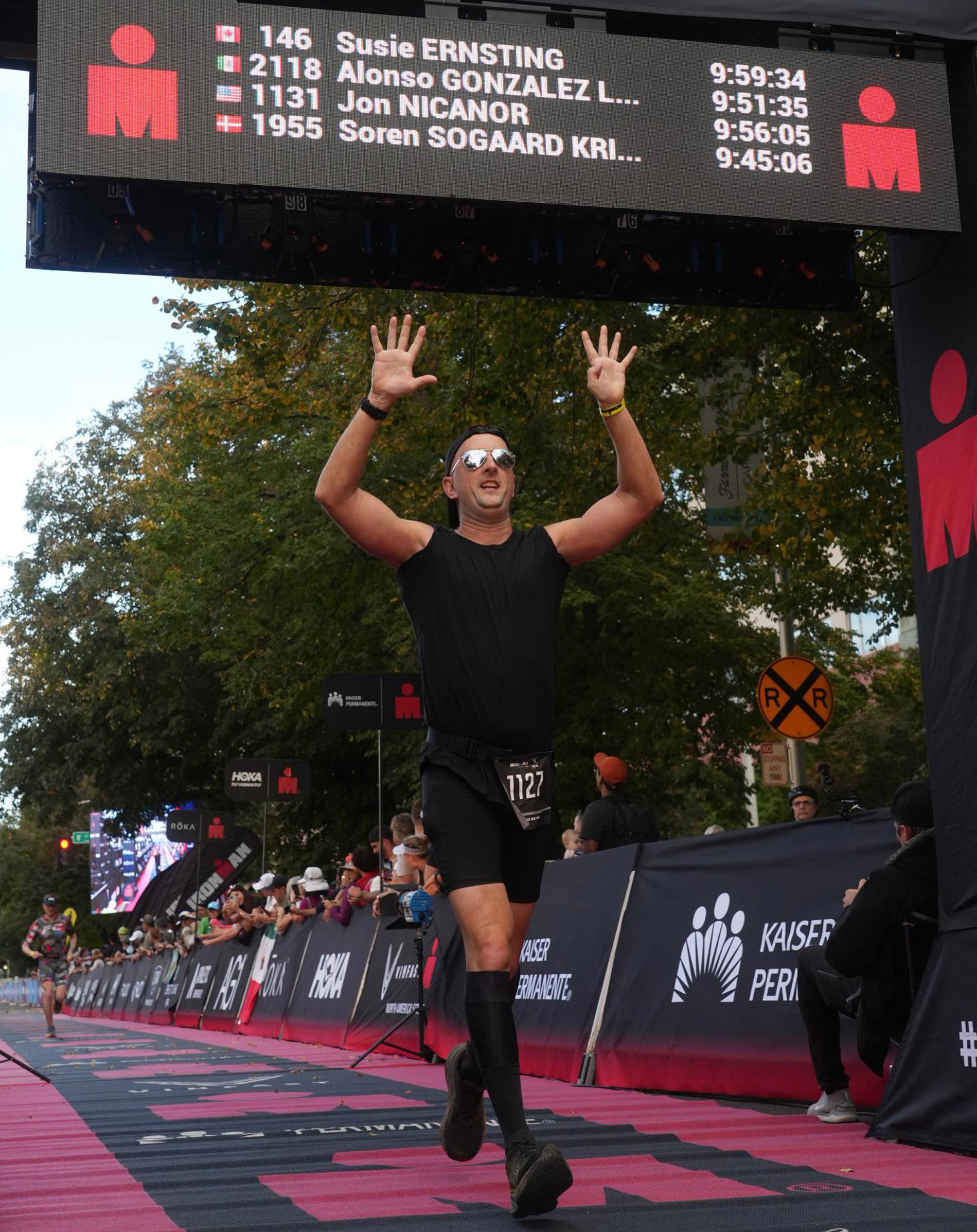
As I crossed that finish I held up 9 fingers to show the realization of my goal 9:XX (whether it was 9:01 or 9:59:99 it didn’t matter to me) and for the first time in my life I got something else I’d always wished for but never experienced.. tears rolling down my face at a finish line from the emotion all those 10 hours, 6 months and 15 years had built it up to. I joke that I never got to that “ugly cry” break down tears moment, but for me this was all I could hope for. And the wild part is I never had to really hurt, dig deep, push through or crawl to the finish to get there. It just unfolded pleasantly and as I’d hoped for, not a cake walk but never a death march. The perfect ending to a perfect day.

Closing Advice/Takeaways –
I’ll share a separate “Top 10 Advice” post as a follow-up but for closing I’d like to recommend as advice for a good experience to any Ironman athlete, having missed myself so many times before, to A) slow down, B) carb up and C) trust yourself. Always do what you need to do regardless of the clock, get as much carbs as you can as I suspect this is 90% of why races go south and find a way to build confidence in trusting yourself, in Ironman or anything you do.
In no exaggeration this has been one of the best experiences of my life – the tearful finish line, the long weekend with friends and family, and the months of getting reacquainted with a lost love. Once you have a moment like that it’s yours forever. I’m not sure if I’ll do another one, but finally I don’t feel the need to prove anything anymore with this distance, everything beyond here is gravy.
 David Welby